Market In A Snap! April 18th – April 22nd, 2022

By: Jeff Anderson, CFA

CloseWeekly returnYTD return
S&P 5004,271.78-2.75%-10.37%
Nasdaq Composite12,839.29-3.83%-17.93%
Russell 2,000 1,940.66-3.21%-13.57%
Crude Oil$101.22-5.0%34.13%
US Treasury 10yr Yield2.90%1.3%91.52%

Source: Wall St. Journal

Market Wrap:

The major indices suffered another week of losses as investors digested Fed Governor Powell’s comments earlier this week. Mr. Powell is committed to fighting inflation and the next meeting on rates in Mid-May looks like a 0.5% increase in interest rates will be the decision. There are even rumblings of a potential 0.75% hike. Investors worry that an aggressive interest rate hike stance will slow economic growth and hurtle the US into a recession. No one knows definitively if a recession will happen, but the market is acting like it is a foregone conclusion. The economy moves in cycles. Recessions are a part of that cycle. That is undeniable. While the market continues to fret over these fears, the US economy is in good shape. Corporate earnings have been, for the majority, strong. The consumer continues to spend and has elevated savings levels. Airlines had a great first quarter. Despite higher air fares, people are taking to the skies. Steel companies are doing well. Tesla cannot keep up with demand. Will this be the case in 6 to 9 months? It is anybody’s guess. Goldman Sachs said this week that there is now a 35% of a recession in the US within the next two years. To me, that is a useless piece of information. That’s just fence-sitting. As markets fall, they do become cheaper. Maybe earnings will fall, or slow at a faster pace than anticipated, but this is cyclical, not necessarily secular. The S&P 500 is trading below 18 times this year’s estimated earnings. That is near its historical average. It is less expensive than it has been for years. Looking out five years from now, will corporate America be earning more than today? Odds are they will. There may be a pullback or two along the way, but it is a reasonable bet. Famed investor Warren Buffet has always maintained that the US economy is much more resilient than many people think and that, over the long-term, investing in corporate America pays off. Being able to ignore the short-term market fluctuations and being able to invest during bear markets gives the investor much better odds at reaching their retirement goals.

“Bonds don’t work anymore”

I’ve heard this a few times recently. The first quarter of this year saw both stocks and bonds lose value. That is rare. Given the inflationary environment we’re in, it’s not terribly surprising. Bonds move in the opposite direction of interest rates. The longer the maturity, the more dramatic the price declines when interest rates increase. Longer maturity bonds are more sensitive to changes in interest rates. At some point, rate hikes will slow, or stop, and bonds that have lower coupons (the “interest rate” part of the bond) will mature and can be reinvested at higher interest rates. Having yields too low isn’t healthy long-term. The reason they were low was because of the pandemic. The fear was deflation, not inflation. As the Fed raises rates, inflation will start to come down. Add in improvements in the global supply chain and an end to the war in the Ukraine and we could see inflation well below 5%, and even closer to 3%.  At that point, rates will stop going up and it will give the Fed the tools necessary to tackle the next recession or, God forbid, another pandemic-like event. Having rates stuck below 2% coming into a recession leaves little room for the Fed to help. Restoring balance after the global pandemic is what’s important.

So, are bonds still a good investment? Yes. They are a vital component of a well-diversified portfolio. They should return to providing a ballast to the equity portion of a portfolio. They should offer more attractive income returns, and they should be less volatile than equities. Judging any asset class over a short period is a poor way to think about your portfolio.  Over the short-term, it’s the uncertainty that worries investors. As we have said many times in the past, there is no such thing as certainty. The world is uncertain. Embracing uncertainty is paramount. Put away the foggy crystal ball. Remember that you have a plan that lays out a path to reaching your financial goals.

Market In A Snap! April 11th – April 15th, 2022

By: Jeff Anderson, CFA

CloseWeekly returnYTD return
S&P 5004,392.59-2.39%-7.84%
Nasdaq Composite13,351.1-3.93%  – 14.66% 
Russell 2,000 2,004.98-0.24%-10.7%
Crude Oil$106.548.83%41.21%
US Treasury 10 yr Yield2.83 %17.1%131.6

Source: Wall St. Journal

Market Wrap:

The major indices continued their slide in this shortened week as US Government bond yields continued to rise. In a recent CNBC interview, Federal Reserve Governor Christopher Waller said getting inflation under control will require raising interest rates at a faster pace than normal, even though the rate of price increases has probably peaked1. The probability that the Fed will raise rates by 0.5% vs the previously assumed increase of 0.25% has risen dramatically. 

Fed Chairman Powell has history to guide him. Prior to Fed Chairman Paul Volcker getting aggressive with rate rises to bring down a multi-year battle with high inflation, his predecessor Arthur Burns was the opposite. Economic historians said Governor Burns “lacked the analytical framework to assess the interplay between the real economy and inflation, and how that relationship was connected to monetary policy.”2 By the time Volcker replaced Burns, inflation had become systemic. President Nixon had closed the gold window in 1971 (known as the Bretton Woods System) to address the country’s inflation problem and to discourage foreign governments from redeeming dollars for gold. His administration also enacted wage and price controls.3 It turned into economic mayhem. Powell is acutely aware of these risks. Better to be aggressive now than to let inflation boil over and create another lost decade.

Mortgage Rates Hit 5%:

Chart, line chart

Description automatically generated

We haven’t seen 5% rates since 2011. The monthly cost of buying a home has surged by more than a third over the past year, according to the Wall Street Journal. Yet, demand remains strong (for now). In areas like Southern California, a strong labor market coupled with extremely low supply could offset this. The cost of building materials has risen dramatically, and homebuilders are forced to charge more to maintain profit margins. It will be interesting to see what the total demand for mortgages is for 2022. In 2021, nearly two thirds of originations came from refinancing. Economists had projected, a few weeks back, that this number would be closer to 30%. As prices continue to rise, so are rents. This upward pressure on rents may push reluctant buyers into the market as the cost of renting may no longer make sense.

China is Back to Covid-19 Lockdowns:

A picture containing person

Description automatically generated

Just when we thought covid-19 and all its variants were in the rearview mirror, China is back to mass lockdowns. Forty-five cities that make up nearly 40% of China’s economic output are in some form of lockdown. This equates to roughly 370 million affected Chinese residents. There is already significant disruption to the Chinese economy, and it won’t help the global economy fight its way out of its supply-chain issues. Let’s hope this is the last set of measures necessary to put an end to this pandemic.

Market In A Snap! April 4th – April 8th, 2022

By: Jeff Anderson, CFA

CloseWeekly returnYTD return
S&P 5004,488.65-1.26%-5.82%
Nasdaq Composite13,711.0-3.86%  – 12.36% 
Russell 2,000 2,002.37-4.24%-10.82%
Crude Oil$97.05-1.42%29.9%
US Treasury 10yr Yield2.713 %32.2%119.3

Source: Wall St. Journal

Market Wrap:

The major indices gave back some of the gains from the prior week. Inflationary fears persisted with economists and equity strategists worried that inflation levels will force the Fed to keep raising interest rates which could tip the economy into recession next year.  As of now, the probability of recession (provided by Estrella & Mishkin) remains well below the levels seen in late 2019 or mid-2021.  Economic and geopolitical uncertainty will likely continue to weigh on markets in the short term.  The yield curve has inverted (meaning the yield on the 2-year treasury note is higher than the 10-year note.  This, historically, signals a slowing economy and heightened risks of a recession.  However, equity markets have, on average, rallied for at least a year after the government bond yield curve inverts.  Yet, as we mentioned on our podcast, analyst buy ratings are at multi-decade highs.  The last time that happened was in September, 2011just after the market had sustained a roughly 12% correction. The major indices moved considerably higher over the following 10 years.  This is not to say that the markets will perform similarly, but rather that trying to time the market can be costly. There is no crystal ball. Just history to guide us.  

Warren Buffet is Investing During this Market Correction:

Despite the terrible start to the equity markets in 2022, Warren Buffet has been putting money to work.  Berkshire Hathaway bought stakes in Occidental Petroleum, HP, and is acquiring all of insurer Alleghany Corporation.  All told, these investments amount to almost $24 billion.  At the end of 2021, Berkshire was sitting on over $145 billion in cash. For those of you who have followed Warren Buffet over the years, you know that he doesn’t make investment decisions based on macro-economic events. He simply like to buy (or invest in) companies that have favorable long-term business characteristics. The market correction didn’t prevent him from making investments. That is a good message for investors.  

“Interest-Rate Surge Ripples Through Economy…”:

Graphical user interface, chart, line chart

Description automatically generated

As the Federal Reserve embarks on lifting interest rates, the cost to purchase homes and autos have surged higher.  Mortgage rates are approaching 5%, up from 3% at the start of the year.  Rates are still low historically, but the sudden increase is making it harder for many to purchase homes.  Same can be said about auto loans.  As for as homes are concerned, prices would need to decline to make it affordable.  In areas like San Diego, the low supply of homes coupled with low rates pushed prices higher.  As rates move higher, it should push some potential buyers to the sidelines which “could” bring down the price of homes.  For buyers who can’t wait, they may be forced to look for smaller homes or areas further away from metro centers.  Given how much home prices have increased over the past few years, a pullback would not be abnormal, and should make some areas more affordable again.

Graphical user interface, chart, line chart

Description automatically generated

Market In A Snap! March 28th-April 1st, 2022

By: Jeff Anderson, CFA

CloseWeekly returnYTD return
S&P 5004,545.86.06%-4.62%
Nasdaq Composite14,261.50.65%  -8.84 % 
Russell 2,000 2,091.11.63%-6.87%
Crude Oil$99.42-11.72%31.77%
US Treasury 10yr Yield2.385 %-9.37%

Source: Wall St. Journal

Market Wrap:

Thursday marked the end of the first quarter.  By mid-March, the S&P 500 was down 12.2% for the year but clawed back all but 4% of its losses.  The Nasdaq 100 was down 20% by mid-March. By Thursday, it was down ~ 8%.  It has been a wild quarter.  Fed rate hikes, geopolitical tensions, and a new wave of lockdowns in China all contributed to a rough start to 2022.  It’s enough to test anyone’s nerves.   

Mortgage Rates Spike:

The 30-year fixed-rate loan jumped to 4.67%, according to Freddie Mac.  That is quite an increase from 3.22% at the start of this year. In January 2021, rates were below 2.7%.  This likely isn’t a shock to many. The yield on the US 10-YR Treasury Note is well above 2%, up from 1.2% in August of last year. The Federal Reserve raised rates at the March meeting and, at present, intends to continue the path of rate hikes through this year and into next year to bring down inflation.  With higher mortgage rates, refinancing are expected to drop dramatically.  They are expected to make up 33% of mortgage originations this year, down from nearly 60% in 2021.  That has put pressure on home prices.  Median home prices had increased nearly 24%, year-over-year in March of 2021.  That pace has slowed to 15%.  It will be interesting to see what the data looks like after a few months of mortgage rates near, or above, 5%.

Real Estate Loans:

Despite the increases in home prices, Residential Real Estate loans are well below the peak during the recession of 2008.

Debt levels are much better.  Values are much higher.  Household balance sheets are also, obviously, in better shape.  Regardless, mortgage rate increase shocks are definitely a headwind for housing.  Historically speaking, mortgage rates are still below their long-term average.  The rate of change is, in the short term, what really matters.  Home Equity Lines of Credit are nowhere near the levels of 2008.  Savings rates are higher as well. But housing is cyclical.  The rapid growth in home values is declining and may continue to do so for the foreseeable future as the Fed tries to wrestle down inflation.

Market In A Snap! March 21st-March 25th, 2022

By: Jeff Anderson, CFA

CloseWeekly returnYTD return
S&P 5004,543.061.79%– 4.68%
Nasdaq Composite14,169.301.98%  – 9.43% 
Russell 2,000 2,076.97-0.44%-7.50%
Crude Oil$112.687.17%22.51%
US Treasury 10yr Yield2.481 %33.0%

Source: Wall St. Journal

Market Wrap:

Last week, the Federal Reserve officially kicked off their rate-hiking cycle by increasing the Fed Funds rate 0.25%. Fed Governor Jay Powell signaled consistent rate hikes would likely come with each quarterly meeting. The 10-Year Treasury yield is nearing 2.5%.  Mortgage rates are solidly above 4%, putting more pressure on potential homebuyers.  Gasoline is over $6 per gallon in many parts of California.  Everything’s getting more expensive.  Yet, despite this, the S&P 500 is up ~3.5% since last week’s Fed meeting.  That is not say that the rebound in equity markets will continue. The rebound caught many “pundits” off-guard.  Could the markets be responding to a belief that the Fed will bring down inflation and keep the economy from overheating, or falling into a recession?  Possibly.  Does anyone really know where the market is headed over the next nine months?  Absolutely not.  Having a well-diversified portfolio and a long-term approach to investing can help investors tune out the noise and avoid making emotional decisions that may derail their retirement goals.

Initial Jobless Claims Fall to Lowest Level in 50 Years:

Chart, histogram

Description automatically generated

Simply put, initial jobless claims reflect just how tight labor markets are. Nancy Vanden Houten, lead economist at Oxford Economics was quoted saying, “In an environment where employers are struggling to hire and retain workers, layoffs are going to be at a minimum.”  This figure is exacerbated by the fact that roughly half a million fewer people were in the labor force in February.  We have 6.3 million unemployed people in the US yet there were roughly 11.3 million open positions in January.  Such an imbalance will likely continue to put upward pressure on wages.

Gas Prices Increase at Fastest Pace on Record:

Chart, histogram

Description automatically generated

Americans are acutely aware of the sudden, and dramatic, increase in gas prices. In fact, the increase is the fastest on record.  There is some good news.  Prices, adjusted for inflation, are still well below the peak in 2008-2009.  The prices vary state by state due to factors such as taxes and gasoline specifications.  In addition, “gasoline inventories are below their five-year historic range in the West Coast region and above average for this time of year in the Midwest, according to the EIA.”  When will prices go down, or at least stop going up?  That’s anybody’s guess.  Putting more rigs in the ground in the US along with other supply increases globally and an end to the Ukrainian conflict should help. 

Map

Description automatically generated

Market In A Snap! March 14th-March 18th, 2022

By: Jeff Anderson, CFA

CloseWeekly returnYTD return
S&P 5004,464.126.15%-6.36%
Nasdaq Composite13,899.078.18%  -11.19% 
Russell 2,000 2,084.365.29%-7.17%
US Treasury 10yr Yield2.154 %15.2%

Source: Wall St. Journal

Rate Hikes are Here:

The Federal Reserve raised its overnight rate by 0.25%. Chairman Powell signaled rate hikes would happen at every meeting this year. The Fed’s “Dot Plot” now sits at 2% for the end of 2022. That’s quite an uphill climb from where we are now.  Inflation is “numero-uno” in terms of the Fed’s biggest concern. The economy is strong enough to handle higher rates, according to Mr. Powell.  Economists are projecting inflation to top out around 9% before going lower. Despite the sobering news on inflation and interest rates, the markets shrugged it off, along with the heightened risks in Ukraine. The markets don’t like surprises and currently, everything is definable. There are surely more surprises around the corner but for now, the attitude is, “OK, things aren’t great, but at least we know what we’re facing.” 

Despite the kick-off in rate hikes, the markets responded strongly, with the Nasdaq leading the charge, up 8.2% for the week, despite the 2020. 

How to Manage the Biggest Risk of All: Uncertainty:

Bloomberg columnist, Allison Schrager put out a good piece on explaining the difference between risk and uncertainty.

We are living with much less risk historically speaking. Ms. Schrager goes on to explain the difference between the two. “Risk can be managed with insurance or hedging; Uncertainty demands flexibility.”

“Our first instinct, when faced with more uncertainty, is to avoid making decisions, bulk up on cash, don’t relocate, wait on retirement, and avoid new debt.  But the heightened uncertainty may last a long time and you can’t just keep life on hold.”

I couldn’t have said it any better.

Russia’s Share of Commodity Production:

Commodities have been on a tear since the Russian invasion of Ukraine. Morgan Stanley Research put out a chart of Russia’s share of the major commodities. Palladium is used in catalytic converters for automobiles. Russia’s share is almost 40%. Wheat, oats, rye and barley, oil and gas are also major exports of Russia. The S&P Commodities Index is up nearly 29% year-to-date but had peaked at 46.5% last week. This is one of the reasons why inflation could touch 9%. 

Inflation Now vs the 1970s:

Food and Energy costs currently take up 10% of consumers’ budgets, half as much as they did back in the ‘70s says Steven Blitz, chief U.S. economist at TS Lombard.  That’s the good news, now the bad news. Mr. Blitz goes on to state that the “long peace from 1989 to 2019” is over. Globalization is reversing as the US on-shores more production, the global supply chain that puts downward pressure on prices will reverse. It doesn’t mean stagflation necessarily, but it “raises the risk of credit sensitivity in the economy.

Market In A Snap! March 7th-March 11th, 2022

By: Jeff Anderson, CFA

CloseWeekly returnYTD return
S&P 5004,204.31-2.88%-11.79%
Nasdaq Composite12,843.81-3.53%  -17.90% 
Russell 2,000 1,979.67-1.06%-15.86%
US Treasury 10yr Yield1.998 %.26%

Source: Wall St. Journal

“Beware The Ides of March”

Inflation, Taxes, and Market Crashes.  Those are the three “big” things affecting retirement savings.  It’s the cornerstone of our philosophy.  This month, unfortunately, has experienced all three.  Many of us are preparing to file taxes next month.  Inflationary pressures have increased with the Russian-Ukraine conflict, and to top it off we’re amid an equity market correction brought on by geopolitical events changing monetary policy and inflation which, unfortunately, looks like it will stay higher longer.  It is times like these that can really test our faith.  Will oil prices tip us into recession?  Are we headed towards a 1970’s style stagflation?  Will things ever get back to “normal”? Are these the questions we thought of on our own or are they the rumblings of the financial news media looking to grab our attention?  Well, they have our attention.  Fortunately for us, we have history on our side.  There aren’t many (if any) decades over the past 120 years that didn’t involve volatile markets, wars, or inflation/deflation/stagflation.  

What is stagflation?  Stagflation is characterized by slow economic growth and high unemployment accompanied by risking prices (i.e., higher inflation).  We certainly aren’t in a stagflation environment now.  Unemployment is low and growth is still strong (but slowing in some areas).  Things can obviously change, and with oil prices marching higher and higher and $6 per gallon prices at the pump, the pressure on our wallets is tighter.  Airlines are increasing ticket prices to help with rising fuel prices which may temper people’s appetite for planning vacations. Food costs will likely remain elevated given the cost of transportation.  The economy moves in a cycle, and it always has, and until someone invents a better economic model for society, it will continue to do so.  But, as of today, the odds of a ‘70 style stagflation are low. Like sports betting, odds can change.

We will always have something to worry about, but putting things in context, having a plan, and most importantly being able to reduce the noise will be the best antidote.

Breaking Down Inflation:

We may be at risk of beating the dead horse of  “inflation, inflation, inflation”.  Can we stop talking about it?  Hopefully, we will be able to look at it in the rearview mirror like we have with COVID-19.  For the time being, we’ll write about it when we think there’s something noteworthy. 

The Wall Street Journal put out a good piece on where the 7.5% rise in consumer prices in 2021 came from.  Which is the rate at the end of February which clocked in at 7.9%.  Prices are likely to remain elevated for at least the first half of 2022.  If the Ukrainian conflict continues into the summer, prices may go even higher. 

See the chart below highlighting all the components of inflation.  

Market In A Snap! February 14th-February 18th, 2021

By: Jeff Anderson, CFA

This Week: It’s that time of year again when the investment community pours over Hedge Fund’s must submit a 13-F filing every quarter, with the latest due date being February 15th. Traders love to comb through the holdings of the largest hedge funds, hoping to see what they are buying and where they are exposed the most. The headlines on Bloomberg.com and the Wall St Journal highlight the buys and sells of the main holdings for the most well-known fund managers. Investors may want to caution from trading off these reports, as some of those term investors. When certain companies’ shares are highly concentrated in the hands of hedge funds, they can be extremely volatile around earnings.

Crude Oil closed at $91.69 per barrel, down 2.35% for the week.

US Households Ramp Up Credit Card Spending:

Rising costs for homes, autos and “stuff” has resulted in buyers borrowing larger amounts to finance these extra costs (see table). For now, lofty home prices and newly used cars valued above sticker price are keeping debt to equity ratios in decent shape, but if used car prices normalize, many could find themselves upside down on their auto loans. On a positive note, owner’s equity in real estate surpassed $25 trillion in 2021.

Intel agrees to buy Tower Semiconductor Ltd. Mergers and acquisitions are estimated to be strong this year, and Intel threw their hat into the ring with this recent announcement. The acquisition is valued at $6 billion. Intel was valued at roughly $200 billion at the time of the announcement. The company said it also has plans to invest at least $20 billion in new chip-making capacity in Ohio to meet the insatiable demand for digital products. In total, Intel lans to invest close to $100 billion more in manufacturing. The Ohio announcement reverses a multi-decade push to offshore chip manufacturing. The challenges with supply-chain disruptions brought on by the global pandemic coupled with geopolitical tensions with China and Taiwan are forcing many companies to bring back manufacturing to American shores.

Market In A Snap! February 7th-February 11th, 2021

By: Jeff Anderson, CFA

This Week: Volatility in the bond and equity markets continued this week. The S&P 500 clawed back over half of its 9.2% sell-off in January early this week, before selling off again.  We are still above the January 27th lows.  Geopolitical risks, pending interest rate hikes, and elevated inflation levels were at the forefront of this week’s market headlines.  As we discussed in today’s podcast, there’s always something to worry about in the short-term, but, as time goes by, those worries become less relevant given the world’s adjustments.

Crude Oil closed at $93.89 per barrel, up 2.1% for the week. The latest CPI release coupled with a more imminent threat of Russia invading the Ukraine, pushed oil higher.  

 CloseWeekly returnYTD return
    
S&P 5004,418.64-1.82%-7.29%
Nasdaq13,791.15-2.18%-11.85%
Russell 2,0002,030.151.39%-9.58%
US Treasury 10yr Yield1.918%0.7% 

Source: Wall St. Journal

Your Recently Purchased Car Might Be Worth More Than When You Bought It:

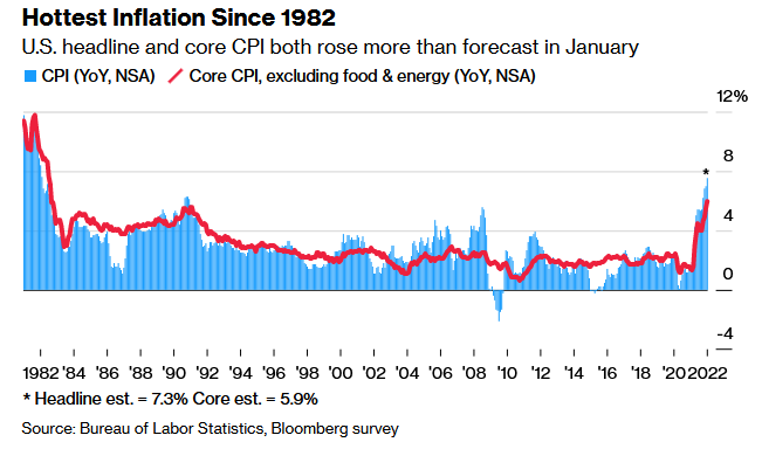
The latest release on the Consumer Price Index showed CPI up 7.5% for the past 12 months, ending January 2022.  In the release, used cars and trucks were up a staggering 40.5%.  There just are not enough cars or trucks.  Supply-chain issues, notably around semiconductor chips, has really put a dent in auto production.  Dealer inventories are at historic low levels.  Automobiles are historically a depreciating asset, but, thanks to supply-chain issues, your car has increased in value.  This is another example of the disruption happening as the global economy is still trying to adjust itself after the pandemic- related shut down.

Large Investment Bank Believes that the Fed Will Hike Rates 7 times this year:

Goldman Sachs stepped up its forecast for US rate hikes for 2022.  Just last week, they were calling for five hikes. Now they believe, based on the recent CPI data, that seven will be required. Although nowhere near the inflation rates in the 1970’s, inflation is elevated relative to the past 40 years.  The Fed is committed to fighting inflation but will have to balance a high-wire act of tamping down inflation without killing the economy.  Credit markets are already adjusting, with the yield on the US 2-year government note up to 1.6% vs 0.12% a year ago. Many of us have never experienced a high-inflation environment.  If/when supply-chain pressures ease, it should help minimize the need for such an aggressive rate hike path.  We likely will not know until the second half of this year.  The Fed, under Governor Powell, has shown itself to be able to change course when the data changes.  Longer- dated US government bond yields are not moving up as quickly as the shorter- dated bonds, implying that rate hikes are more likely to slow the economy. As short duration bonds mature, the proceeds can be re-invested at higher rates. At least that is a positive.

Market In A Snap! January 31st-February 4th, 2021

By: Jeff Anderson, CFA

This Week: It was another volatile week for the domestic equity markets with the Nasdaq clawing back some more of its early 2022 losses.  Small cap stocks continue to lag large cap stocks. Facebook (technically now called Meta Platforms Inc) reported disappointing earnings this week which ended up shedding over $200 billion in market value.  Amazon however, reported strong earnings and finished up 9% on the week.  It has been a strange earnings season, as companies like Netflix and Facebook fell on hard times while the likes of Amazon, Alphabet and Microsoft reported blow-out earnings. The latter three are more indicative of the state of the economy, while Netflix and PayPal face some company-specific issues, somewhat related to lofty expectations coming out of the pandemic. Facebook specifically is dealing with the fallout from Apple’s software update that allows users to block tracking has put Facebook’s advertising dependent business model in jeopardy, at least for the short-term.

Crude Oil keeps marching higher, closing near $92 per barrel, up 5.3% for the week, and 21.84% year-to-date. Continued geopolitical issues surrounding Ukraine along with strong economic numbers have propelled oil higher.

Investor Bulletin – Corrections are Normal:

The correction to US Equity markets that came swiftly as the new year began is, by historical standards, normal.  Oxford Economics studied corrections going back to 1945 and found that the Black Monday crash that occurred in 1987 is the only example of markets correcting more than 20% without any recession to follow. The chart below shows the corrections to the S&P 500 dating back to 1965.  You can see that the average correction in which a recession did not follow was -15.4%.  Economists are not calling for a recession anytime soon.  According to Crandall, Pierce & Co, the average correction for the S&P 500 fell between 10% and 20%.  It would be normal market behavior for this correction to reach the typical bottom. But we shall see. The Nasdaq was off nearly 17% before bouncing off its lows on January 27th. It did not breach a 20% correction, which is defined as a bear market. This is not to say that the correction is behind us but rather, to point out that corrections are a normal part of investing in the market.

U.S. Hiring Accelerated as Employers added 467,000 Jobs (WSJ):

Payrolls grew by nearly 500,000 in January.  The Labor Department also revised payrolls upwards for November and December of 2021, with more than 700,000 additional jobs created during that period.  Service-type jobs and retail added jobs while the auto industry shed jobs.  There are still about 3.6 million people who are not working due to illness (mainly Omicron).  As the virus subsides this year, many economists are expecting a continued bounce back in jobs, even as the unemployment rate sits at 4%.

With wage increases and demand from employers for more workers, the Fed is likely to raise interest rates.  Some economists believe the Fed could raise rates in March by 0.5% instead of the typical 0.25%, as well as raise rates in June and December.  Considering this is a mid-term election year, many feel that the Fed will pause in Q3 due to the election and will resume rate hikes in December.  We have written about this many times over previous market updates.  Nothing is set in stone.  The Fed will either dial back rates or will get more aggressive as additional economic data comes in.