Market In a Snap! April 10th – April 14th, 2023

By: Dave Chenet, CFA, CAIA®

 CloseWeekly returnYTD return
    
S&P 5004,137.520.79%7.77%
Nasdaq Composite12,123.470.29%15.85%
Russell 2,0001,781.161.50%1.23%
Crude Oil82.662.14%2.98%
US Treasury 10yr Yield3.52%  

Source: YCharts, Yahoo! Finance, WSJ

Market Recap

A busy week for economic data which, on the whole, showed slowing economic growth and moderating inflation pressures pushed equity indices to modest gains.  Inflation data, highlighted by the CPI and PPI reports, came in below expectations with the forward-looking PPI report posting its largest month-over-month decline since the start of the pandemic.  Meanwhile, data on the health of the US consumer was mixed; retail sales fell 1% for the month of March while sentiment data ticked up (from still low levels).  

Also released this week were the minutes from the Federal Reserve March meeting which showed growing concern amongst central bankers that recent banking stress would lead to “a mild recession” later this year.  Troubling, however, was that the report also noted inflation remains “unacceptably high” and that the reduction in inflation was progressing with “slower-than-expected progress.”  While the Fed may be nearing the end of its rate hiking cycle, it may defy market expectations for rate cuts by year-end absent significant deterioration of the labor market, which continues to hold up reasonably well.

Investors will focus on Q1 earnings next week and will hope that strong momentum continues after a solid beat by JPMorgan.


What We’re Reading:

FT: Banking tremors leave a legacy of credit contraction

The Hill: Why the 1980s Recession Haunts the Fed

Chart of the Week:

The tech-heavy NASDAQ index and the Small-Cap Russell 2000 index have deviated in recent weeks, with the NASDAQ significantly outperforming.  Markets may be recognizing that smaller companies have a higher reliance on bank financing and the recent banking turmoil has significantly tightened credit conditions.  Alternatively, investors may be renewing hopes of another tech-driven run despite high valuations and a higher interest rate/inflationary environment.

Market In a Snap! March 27th – March 31st, 2023

By: Dave Chenet, CFA, CAIA®

 CloseWeekly returnYTD return
    
S&P 5004,109.313.48%7.03%
Nasdaq Composite12,221.913.37%16.77%
Russell 2,0001,802.483.88%2.35%
Crude Oil75.676.55%-5.68%
US Treasury 10yr Yield 3.49%  

Source: YCharts, Yahoo! Finance, WSJ

Market Recap

March finished on a positive note, with the S&P 500 advancing 3.5% on the month and 6.4% above the March 10th lows.  Easing concern about the banking sector and slowing inflation gave rise to the hope that the Fed will achieve a ‘soft landing’ – bringing inflation down towards its 2% target without pushing the economy into outright recession.  Under the hood, gains in tech and communication services offset losses in financials and real estate.  Regionally, Emerging Markets outperformed developed markets and bonds finished the month higher as treasury yields fell.

On a quarterly basis, both stocks and bonds were broadly higher.  European markets were the best performer for the second consecutive quarter and have significantly outpaced US stocks over that period as easing recessionary fears, hope of peaking inflation and very low valuations, and a falling US dollar vs the Euro all supported European stocks (in US dollar terms).  

Looking ahead, we are two weeks away from the start of a pivotal earnings season.  Investors will keep a keen eye on companies’ expectations around revenue growth and the impact of higher rates on corporate profits.


What We’re Reading:

Mohammed El-Erian: What happens in the Banking Sector Won’t Stay There

Richmond Fed President Barker: The Need to Be Nimble

Federal Reserve: Senior Loan Officer Opinion Survey on Bank Lending Practices

Chart of the Week:

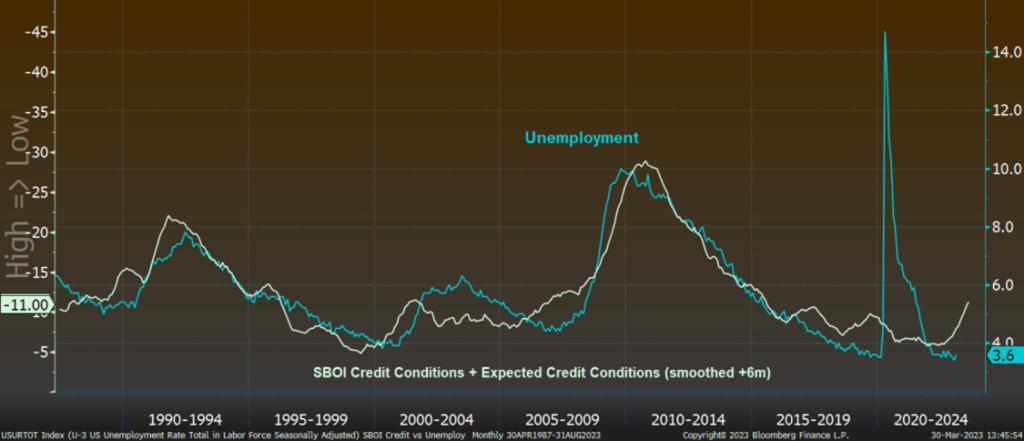
While the actions from the US Treasury to quell the banking turmoil of the last few weeks may have alleviated the immediate pressure on banks, the economic impact may be yet in its early stages.  Data suggests that banks are tightening lending standards, which is a leading indicator for the health of the labor market.  Should credit conditions remain tight, the likelihood of recession is materially higher.

Market In a Snap! March 13th – March 17th, 2023

By: Dave Chenet, CFA, CAIA®

 CloseWeekly returnYTD return
    
S&P 5003,916.641.43%2.01%
Nasdaq Composite11,630.514.41%11.12%
Russell 2,0001,725.89-2.50%-2.01%
Crude Oil66.34-8.90%-17.34%
US Treasury 10yr Yield3.395%  

Source: YCharts, Yahoo! Finance, WSJ

Market Recap

Major US stock indices finished the week higher amidst volatility driven by continued pressure in the banking sector as both the government and other large banking institutions took action in attempt to provide liquidity to smaller banks facing large outflows and also to shore up confidence in the banking sector as a whole.  In a “flight to quality” trade, investors pushed higher the prices of US treasury bonds and gold this week. 

Investors will be very focused on the Federal Reserve next week to see if the stress in the banking sector will be enough to convince the Fed to pause its rate-hiking cycle.  The Fed knows that fiscal policy impacts the economy on a lag and that its aggressive tightening contributed to the troubles experienced by SVB and others (albeit, poor management and other mistakes certainly were also contributing factors).  The Fed must, however, balance these risks with the risk of giving up ground in its fight against inflation.  Market expectations on the path of the Fed have changed drastically, with the market now expecting the Fed to begin cutting short-term rates by the end of the year.

Our analysis of the data suggests that inflation will continue to moderate as the fiscal tightening continues to depress consumer spending and excessive credit creation.  However, we do not believe that inflation will fall back below 2% in the short-term as short-term rates are still below the level of inflation and the provision of liquidity to the banking sector increases money supply.  While the Fed is very likely close to the end of their hiking cycle, the market may be too sanguine to expect outright rate cuts by year-end.  As such, we continue to have conviction that investors will be well-served by reducing their exposure to non-profitable speculative stocks and seeking the stability of companies with high quality balance sheets, stocks that pay dividends and high quality bonds.  This turmoil will eventually dissipate, but in the meantime, a focus on quality and safety is prudent.


What We’re Reading:

WSJ: Tech Stocks Seem to Be a Haven From the Banking Crisis, for Now

CNBC: Long-awaited Fed digital payment system to launch in July

Moody’s Analytics: Going Down the Debt Limit Rabbit Hole

Chart of the Week:

With the talk around the Fed’s action around increasing the short-term Federal Funds Rate, there has been very little talk about the reducing in the size of the Fed’s balance sheet, which ballooned to just under $9T by mid-2022.  Since then, the Fed has been engaged in a monthly reduction in balance sheet assets, or “Quantitative Tightening (QT).”  QT reversed last week, with the ~$300b in liquidity provided to banks reversing almost 6-months of tightening.

Market In a Snap! March 6th – March 10th, 2023

By: Dave Chenet, CFA, CAIA®

 CloseWeekly returnYTD return
    
S&P 5003,856.78-4.66%0.45%
Nasdaq Composite11,138.89-4.71%6.42%
Russell 2,0001,772.70-8.09%1.02%
Crude Oil76.50-3.61%-4.46%
US Treasury 10yr Yield3.695%  

Source: YCharts, Yahoo! Finance, WSJ

Market Recap

Markets finished the week on a negative tone, as tech-focused lender Silicon Valley Bank (SVB) was shuttered by US regulators.  SVB, the 16th largest bank in the U.S., ran into difficulties as withdrawal requests (a short-term liability to the bank) were backed by a portfolio of long-dated treasury and mortgage backed bonds (long-dated assets).  This liquidity mismatch, coupled with losses associated with the price of the bonds which had been purchased in a lower interest rate environment, prompted a failed attempt by the bank to raise additional capital.  The Federal Deposit Insurance Corporation (FDIC) will step-in to protect the insured deposits (the FDIC insures up to $250,000 SVB per depositor) and oversee the sale of remaining SVB assets to meet uninsured deposits.  SVB represents the 2nd largest US bank failure in history, behind only Washington Mutual in 2008.  The default drove significant losses across all sectors of the US market on Friday.

In contrast, economic news was positive on the margin, with Friday’s Nonfarm Payroll report showing employment rising by 311k jobs in February, higher than the 205k increase economists had expected.  The 6-month trailing average of 343k jobs/month is much higher than the estimated 100k/month additional jobs considered necessary to keep up with growth in the working-age population.  Encouragingly for those keeping a close eye on the likely path of monetary policy, wage growth slowed to a 3-month annualized pace of 3.6% from a 4.4% high.  Slowing wage growth eases upward pressure on inflation.

The broad US stock market has given back its year-to-date gains and is back to levels close to where it began the year.


What We’re Reading:

FT: SVB is not a canary in the banking coal mine

FT: China is right about US containment

Inflation in 2023: Causes, Progress and Solutions – Congressional Testimony of Mike Konczal

Chart of the Week:

One key recessionary warning (amongst many) is the persistent gap between wage growth and the rate of inflation.  The US economy is consumer-driven and consumers are continuing to see inflation eat away at their propensity to consume.  Consumer spending has been supported by the stimulus savings that consumers had put away, but the current personal savings rate and data related to credit card balances suggest that American are increasingly turning to debt to amid higher prices…at a time when higher interest rates mean increase the cost of servicing that new debt.

Advisory services are offered through Presidio Capital Management LLC, Registered Investment Advisers.  Past performance is no guarantee of future returns. Investing involves risk and possible loss of principal capital. No advice may be rendered by Presidio Capital Management, LLC unless a client service agreement is in place.

Market in a Snap! February 27th – March 3rd, 2023

By: Dave Chenet, CFA, CAIA®

 CloseWeekly returnYTD return
    
S&P 5004,045.481.90%5.36%
Nasdaq Composite11,689.012.58%11.68%
Russell 2,0001,928.262.13%9.84%
Crude Oil79.804.72%-0.57%
US Treasury 10yr Yield3.96%  

Source: YCharts, Yahoo! Finance, WSJ

Market Recap

Markets began the month of March on a positive note, with gains in cyclically sensitive sectors such as energy, materials, and industrials more than offsetting losses in utilities and healthcare.  On the economic data front, relatively strong global economic data suggested continued central bank tightening may be appropriate in light of inflation remaining above policy targets.

Bond yields, were largely unchanged, settling just below 4% on the benchmark 10-year bond.  Investors, however, are increasing their bets that the Federal Reserve will raise the Fed Funds rate by 0.5% at the conclusion of the March 22nd meeting.  Likewise, markets had entered the year with an expectation that the Fed would be cutting rates by year-end, but now see three quarter-point hikes by the end of the year.

As markets continue to struggle with the unwinding of the unprecedented levels of fiscal and monetary stimulus and the trade-off between growth-restrictive monetary tightening and excess inflation, navigating current financial markets requires a large dose of caution.  Investors must look closely at their asset mix relative to their liquidity needs and financial goals.  A disciplined investment strategy in which decisions are made based on data over emotion will help keep investor portfolios on track despite choppy waters.


What We’re Reading:

Reuters: US seeks allies’ backing for possible China sanctions over Ukraine war

WSJ: Long-Robust U.S. Labor Market Shows Signs of Cooling

FT: Amazon Pauses Construction on its Second Headquarters in Virginia

Chart of the Week:

Index results do not reflect fees and expenses and you typically cannot invest in an index.

In recent years, one of the major arguments for equity market bulls was that “there is no alternative” (referred to as TINA); the crux if this argument that was investors fundamentally choose between buying stocks and buying bonds.  When bond yields were extremely low, stocks appeared much more attractive.  Today, we are squarely in the TARA (there are reasonable alternatives) territory.  The yield on the 2-year treasury is roughly in-line with the S&P 500 earnings yield…for the first time in two decades!

Advisory services are offered through Presidio Capital Management LLC, Registered Investment Advisers.  Past performance is no guarantee of future returns. Investing involves risk and possible loss of principal capital. No advice may be rendered by Presidio Capital Management, LLC unless a client service agreement is in place.

Market in a Snap! February 20th – February 24th, 2023

By: Dave Chenet, CFA, CAIA®

 CloseWeekly returnYTD return
    
S&P 5003,970.04-2.94%3.40%
Nasdaq Composite11,394.94-3.89%8.87%
Russell 2,0001,890.49-2.68%7.52%
Crude Oil76.61-0.29%-4.75%
US Treasury 10yr Yield3.94%  

Source: YCharts, Yahoo! Finance, WSJ

Market Recap

Markets had a tough holiday-shortened week.  Stock and bond prices fell as bond yields rose, reflecting investors’ adjusted views on a Federal Reserve which may need to maintain a restrictive policy stance in light of stickier inflation and diminished signs of a severe economic downturn.  Rates markets reacted to the release of the Fed minutes from the early February meeting which indicated a continued resolve by policy makers to maintain higher short-term borrowing costs in an attempt to cool economic growth and quell inflation.  Additionally, a higher-than-expected print of the PCE price indicator, the Fed’s preferred gauge of inflation, pushed short-term rates back to levels approaching 15-year highs.

While we remain aware of the monthly volatility in inflation data, we also note that the larger trend is one of less severe levels of price change.  CPI data is up 3.5% at an annual rate over the last three months (down from the 9.1% rate witnessed in June of last year) and monetary policy is now at a level at which deteriorating economic conditions could be met with appropriate policy action.  The path to normalization will likely continue to be a rocky one, but we continue to believe in the prudence of a disciplined, long-term approach.


What We’re Reading:

Center on Budget and Policy Priorities: Amid Signs of Economic Improvement, an Overly Aggressive Fed Could Trigger a Recession

WSJ: US to Expand Troop Presence in Taiwan for Training Against China Threat

Chart of the Week:

A decade-plus of US stock market outperformance (>200% outperformance of US vs Emerging Mkts stocks, measured in US Dollar) has lead to a dislocation between market capitalization and the share of global GDP.  As a percent of market cap, Emerging Mkts represent 13% of global stock market value but 50% of global GDP.  As a result, the valuation difference between developed and emerging market stocks are trading at 20-year lows.  These trends represent significant opportunity for investors with a long-term time horizon.

Advisory services are offered through Presidio Capital Management LLC, Registered Investment Advisers.  Past performance is no guarantee of future returns. Investing involves risk and possible loss of principal capital. No advice may be rendered by Presidio Capital Management, LLC unless a client service agreement is in place.

Market in a Snap! February 6th – February 10th, 2023

By: Dave Chenet, CFA, CAIA®

 CloseWeekly returnYTD return
    
S&P 5004,090.46-1.11%6.54%
Nasdaq Composite11,718.12-2.14%11.96%
Russell 2,0001,918.81-3.16%8.95%
Crude Oil79.763.85%-0.67%
US Treasury 10yr Yield3.40%  

Source: YCharts, Yahoo! Finance, WSJ

Market Recap

Stock markets took a pause last week, posting the biggest five-day losses since mid-December, yet remain broadly positive on the year.  The decline was largely due to dampened expectations of a Fed rate cut by year-end as Fed Chair Powell reiterated the committee’s expectations that policy would likely remain tight.  As a result, the policy-sensitive 2 year treasury interest rate rose to 4.48%, its highest level since November and at levels close to multi-decade highs.

As we look forward to data for the week of 2/13-2/17, we keep an eye on continued corporate earnings as well as a much anticipated report on inflation due for release on Tuesday.  Expectations are for CPI to have increased by 0.5% through the month of January with the year-over-year figure at 6.2% – a decline from the previous month.


Chart of the Week:

Despite high profile recent layoffs, the labor market remains on solid footing relative to pre-pandemic levels.

Advisory services are offered through Presidio Capital Management LLC, Registered Investment Advisers.  Past performance is no guarantee of future returns. Investing involves risk and possible loss of principal capital. No advice may be rendered by Presidio Capital Management, LLC unless a client service agreement is in place.

Market in a Snap! January 9th – January 13th, 2023

By: Dave Chenet, CFA, CAIA®

 CloseWeekly returnYTD return
    
S&P 5003,999.092.73%3.80%
Nasdaq Composite11,079.163.81%5.13%
Russell 2,0001,876.64.47%6.55%
Crude Oil80.002.05%-0.31%
US Treasury 10yr Yield3.51%  

Source: YCharts, Yahoo! finance

Market Recap

For our first market recap of 2023, we take a moment to both reflect on the year past and look forward to the year ahead.  2022 was a challenging year for investors; both the broad stock market and bond market finished in negative territory and a blended portfolio of 60% stocks and 40% bonds had its worst year since the 1930s.  The accommodative policies enacted in response to the COVID economic shutdown were quickly reversed as inflation proved less “transitory” than government officials had hoped.  As we turn the page to 2023, however, we enter the year with cautious optimism and focus on a few key areas:

  • Inflation & the Fed: The Federal Reserve was forced to dramatically tighten financial conditions throughout the course of last year to dampen the inflation that had arisen as a result of both fractured global supply chains and increased consumer demand on the back of fiscal stimulus.  Both Fed Funds rates and longer-term treasury rates increased substantially throughout the year, lowering bond prices and letting the air out of interest rate sensitive technology stocks.

Inflation, however, appears to have peaked.  This week gave us encouraging data that the pace of inflation is slowing.  While year-over-year CPI inflation remains high, the last six months has seen the growth of inflation fall to an annualized rate of 1.8% – a level that would signal the Federal Reserve tightening has had the intended effect. 

  • China reopening: China’s zero-covid policy has precluded an economic recovery in the world’s second largest economy, however, Beijing has begun to ease restrictions on travel and activity.  Simultaneously, credit conditions have been easing in China which will likely contribute to an uptick in economic growth and spillover to growth in other economies – notably the export-oriented economy of Germany.

In summary, while short-term challenges remain, the combination of lower stock prices reflecting current pessimism, a less aggressive Fed and a relatively strong US consumer may benefit asset prices in 2023 and beyond.

On a year-to-date basis, cyclical sectors (consumer discretionary, materials, real estate, etc) have been leading the markets higher with defensive sectors (consumer staples, health care, etc) lagging.  Regionally, Europe and Emerging Markets have lead US markets.


What We’re Reading:

NY Times: Tesla Cuts Prices Sharply as It Moves to Bolster Demand

FT: How do the Federal Reserve and ECB differ on tackling climate change?

Roosevelt Institute: The Causes of and Responses to Today’s Inflation

WSJ: US Cancer Death Rate Has Dropped by a Third Since 1991

Chart of the Week:

The S&P 500 fell 25% from its peak on October 12th of last year.  Using data from the 10 previous instances of 25%+ pullbacks since 1940, this has been an attractive long-term entry point for investors and has offered attractive subsequent returns. 

Advisory services are offered through Presidio Capital Management LLC, Registered Investment Advisers.  Past performance is no guarantee of future returns. Investing involves risk and possible loss of principal capital. No advice may be rendered by Presidio Capital Management, LLC unless a client service agreement is in place.

Market in a Snap! December 12th – December 16th, 2022

By: Jeff Anderson, CFA

 CloseWeekly returnYTD return
    
S&P 5003,852.36-2.08%-19.17%
Nasdaq Composite10,705.41-2.72%-31.57%
Russell 2,0001,763.42-1.85%-21.46%
Crude Oil$74.504.08%-1.26%
US Treasury 10yr Yield3.489%  

Source: Wall St. Journal

Market Recap

The Fed hiked rates by 50 basis points this week, bringing the rate up to 4.25% – 4.5%.  This rate hike cycle has the been the swiftest in decades, sending equity and fixed income markets materially lower year-to-date.  It seems like a broken record. Inflation is too high, and the Fed has taken away the punchbowl.  No more free money. No more asset purchases. No more cheap mortgage rates.  Undoing the massive stimulus that flooded the markets in 2020 and part of 2021 have been replaced by a restrictive stance, where money is more expensive and less plentiful. 

The result of this has been a slowing economy. We got more signs that the economy is softening, with the US manufacturing Purchasing Managers Index clocking in at 49. Why is 49 an important number? Anything below 50 signifies a shrinking of the manufacturing economy.  The consumer price index for November also came in slightly lower (which is better) than projected. So, with the economic and inflation data softening, shouldn’t it be a clear sign for the Fed to step away from rate hikes and a hawkish stance?  You’d think, but no.   Why not?  The answer is multi-faceted.  One reason is employment. It’s still too strong.  Unemployment claims remain low, and there are still too many job openings.  The other reason is that one or two months of good inflation data isn’t enough to alter the Fed’s path.  They have said for months and months that they’ll need convincing evidence that inflation is clearly headed back towards 2%.  One or two months of declining rates isn’t enough.  What is ironic about this is that at beginning of the year all the economists and Wall Street strategists were arguing that the Fed was behind the curve. The Fed isn’t restricted enough.  Fast forward to now and these same experts are saying the Fed is “too” restrictive and that unnecessary damage to the economy will be the end result of the Fed’s current direction.

So, what do we know at this juncture?  At the very least, it’s clear that the effects of higher interest rates are taking a bite out of economic activity. Revenues are up in many industries but its from price increases, not volume increases. Many parts of corporate America are selling less stuff but at higher prices. Stocks have been in a bear market for most of 2022, with share losses coming from a decline in the earnings multiple. Call it the “P” Stocks decline because investors are less bullish. They want to pay less for that same dollar of earnings because they believe that earnings have stalled, or maybe declining…. or just not growing as fast as before.  So, heading into 2023, it’ll be all about earnings (the “E”).  Multiples on earnings typically decline “before” earnings actually decline.  It is likely that a recession happens in 2023. Earnings will likely decline. Stock prices will remain volatile.  At some point, hopefully in 2023, inflation will back under control and the Fed will be able to stop hiking rates.  Earnings will bottom at some point in 2023 or 2024 and the next bull market in stocks could resume.  It’s all a cycle.  Don’t forget that.

Market In A Snap! November 7th-November 11th, 2022

By: Jeff Anderson

 CloseWeekly returnYTD return
    
S&P 5003,992.935.9%-16.22%
Nasdaq Composite11,323.338.10%-27.62%
Russell 2,0001,882.744.60%-16.15%
Crude Oil$88.86-4.04%17.8%
US Treasury 10yr Yield3.842%  

Source: Wall St. Journal

Market Recap

The market finally got the inflation data it so desperately wanted on Thursday.  The Consumer Price Index (“CPI”) clocked in at 7.75% annualized for October.  It was a disappointing 8.2% the previous month.  Markets participants witnessed the best day for equities since April 2020.  The Nasdaq Composite was up a whopping 7.35%.  Even the fixed income markets had a huge day, with the Bloomberg US Aggregate Bond Index gaining nearly 2%. That is a massive move in the credit markets.  As you can see from the chart above, all the major US indices are down for the year and still have a way to go.  It should be noted that we are still in a bear market and rallies (which are simply called bear-market rallies) are often more dramatic than rallies during a bull market.  One day doesn’t make a trend, but it goes to show you how sitting out of the market when you have a long-term time horizon can be costly to your returns.  We’ve cited on more than a few occasions how sitting on the sidelines for only a handful of days can have really hurt your returns.  Just think of Thursday’s crazy day.  If the long-term average annualized return for the S&P 500 is ~ 9 to 10%, missing a 6 or 7% return day can all but dash your hopes for the year.  Many of us want to time the market.  This should show you the perils of doing it wrong.  And, worse than that, if you did seem to time it right once, you may be emboldened to do it again…and again.  Eventually it will catch up to you. It is time “in” the market that matters most.  Granted, it also must include having a diversified portfolio that matches your time horizon.

We can’t forget to mention two other important news items. One, is the mid-term elections. It’s been a closer race than many thought. As of Friday, many races are still too close to call.  Odds are still in favor of the Republicans taking the House.  In the Senate, the Democrats have gained a seat and it’s coming down to the wire. If Republicans take both chambers, it will create gridlock which is normally favorable for markets. The other newsworthy note was that Ukrainian forces successfully pushed Russian troops out of Kherson, which was the only regional capital in the south of Ukraine that Moscow had seized.  The Ukrainian resolve has been impressive.  Hopefully, the conflict is closer to the end than the beginning.

https://www.wsj.com/articles/many-house-races-too-close-to-call-as-republicans-make-gains-11668162601?mod=us_lead_story

https://www.wsj.com/articles/ukrainian-forces-gain-on-kherson-as-russia-retreats-11668158517?mod=world_lead_story

Traditional Energy Companies are in the Green Energy Game:

Koch Industries, one the largest private companies in America, is getting into battery technology.  Many of us think of traditional energy companies as climate deniers or evil entities hell bent on destroying our planet in pursuit of profit.  I believe that, in the end, they are energy agnostic. They see where things are going. They want to be suppliers of energy in whatever form the market wants.  In the case of Koch’s investment in battery storage, its not for electric vehicles but rather for storing energy transmitted from wind and solar farms.  Both wind and solar can be intermittent. Having the ability to store energy in large batteries can go a long way to making renewable energy a dependable source for the US power grid. 

Image: wsj.com

https://www.wsj.com/articles/koch-teams-with-startup-to-build-giant-battery-factory-in-georgia-11668131957?mod=business_lead_pos4

Advisory services are offered through Presidio Capital Management LLC, Registered Investment Advisers.  Past performance is no guarantee of future returns. Investing involves risk and possible loss of principal capital. No advice may be rendered by Presidio Capital Management, LLC unless a client service agreement is in place.