Market In a Snap! September 1st, 2023

By: Dave Chenet, CFA, CAIA

 CloseWeekly returnYTD return
    
S&P 5004,5152.50%17.61%
Nasdaq Composite14,0313.25%34.06%
Russell 2,0001,9203.69%9.42%
Crude Oil85.897.37%7.21%
US Treasury 10yr Yield4.17%  

Source: YCharts, Yahoo! Finance, WSJ

Recap of Aug 24th PCM Webinar with Nosh Engineer – VP Fidelity Investments

Link to Webinar Replay

Last week we had the opportunity to sit down with Nosh Engineer – VP of the Capital Markets group at Fidelity Investments to discuss Fidelity’s economic and market outlook for the rest of 2023 and beyond (Link to the replay above).  Nosh touched on many of the themes that we have been highlighting in this newsletter.  Some highlights of Nosh’s comments were:

Inflation: Nosh noted that while headline inflation has fallen to ~3% as of late, core inflation remains well above 4%.  Nosh expects headline inflation to catch-up to core inflation as higher gasoline prices and tight labor markets keep wage inflation elevated.

Fiscal/Monetary Policy: While the Fed has moved monetary policy to restrictive territory, fiscal policy remains loose with the fiscal deficit ~8% of GDP.  Extended deficits must be funded by higher treasury issuance, pointing to upward pressure on interest rates, which in turn makes treasuries relatively more attractive to investors than stocks.

US Stock market valuation: Investors should be aware that persistently high inflation points to a lower Price/Earnings multiple for the S&P 500.  Valuations trading more in-line with a higher interest rate/inflation environment will most negatively impact the “Magnificent 7” mega-cap technology stocks, however, some of those mega-cap stocks appear more attractively valued relative to respective earnings.

Non-US stock market valuation: While European economies continue to struggle through high inflation and energy concerns, they trade at attractive valuations.  Emerging markets, especially, appear to have a tailwind of fundamental growth and attractive valuations.

We hope that hearing divergent viewpoints on the economy/market is helpful and we will endeavor to continue to hold these webinars to offer a view into our ongoing process of understanding and evaluating the investment thesis of some of the leading institutions on Wall St.


What We’re Reading:

WSJ: Chinese Stocks Are In A Slump – and Value Investors Are Excited

WSJ: Student Loans Are Emerging From Deep Freeze, and Borrowers Are Confused

Morningstar: August Jobs Report: Fed LIkely to Pause Rate Hikes As Hiring Frenzy Cools

Chart of the Week:

To support Nosh’s point about valuations and yields, this chart overlays the S&P 500 forward 12m P/E in blue with the Real (inflation adjusted) treasury yield in purple (inverted in this chart).  Typically as real yields rise, stock valuations fall. 2023 has seen a rebound in market valuation but real yields rising above their 2022 peak.  Markets seem to be betting on inflation falling and rates returning to low, supportive levels.

Market In a Snap! July 28th, 2023

By: Dave Chenet, CFA, CAIA

 CloseWeekly returnYTD return
    
S&P 5004,5821.01%19.34%
Nasdaq Composite14,3162.02%36.79%
Russell 2,0001,9811.02%12.66%
Crude Oil80.365.02%0.41%
US Treasury 10yr Yield3.79%  

Source: YCharts, Yahoo! Finance, WSJ

Recap of Presidio Capital Management Webinar We had hoped to share a replay of the webinar that we hosted this week with special guest, John Tousley, CFA, Managing Director – Goldman Sachs.  However, due to an unnamed staff member selecting ‘pause recording’ instead of ‘record’ (don’t worry, Dustin, I won’t tell anyone it was you), we do not have a recording to share with those of you who were unable to attend.  So, instead, below are a few highlights from the conversation:  

  • Dustin hosted John Tousley for this conversation.  John is the Global Head of Market Strategy for Goldman Sachs Asset Management.  He is regularly featured on financial news television and consults with institutional investors on delivering successful long-term outcomes.
  • Dustin laid out the case for investor caution, including Fed rate hikes and ‘higher for longer’ rates in the face of persistent inflation causing problems for consumers & corporations (credit card/auto loan delinquencies, rising borrowing costs, lower corporate profit margins and reduced hiring).  Dustin made the point that the current AI/tech rebound may be too optimistic in light of the economic backdrop.
  • John presented the case for optimism.  He highlighted potential for the Fed to stop hiking rates, improving economic activity indicators, and an AI-driven productivity boom.  Despite his view of a “soft” landing, John expressed a Flat & Fat thesis, where equity gains are constrained by higher interest rates. 
  • Dustin and John took a deep dive into the investment landscape and highlighted opportunities for investors in each asset class.
    • Cash: While a tactically useful asset class to take advantage of a potential pullback, cash yields will likely fall with interest rates.
    • Fixed Income: Despite 2022’s challenges, fixed income is an important part of a diversified portfolio.  In today’s environment, it offers yield and the potential to be a ballast to the more volatile equity positions.  Investors should be selective, however, of the credit risk within their fixed income positions.
    • Stocks: While Tech/AI has been the story thus far in 2023, there is opportunity for a “catch-up” in cyclical areas of the market, including small/mid cap and non-US markets.
    • Real Assets: In a period of global economic recovery and sustained higher levels of inflation, certain commodities look attractive.
  • Overall, both Dustin and John stressed the importance for investors to build an investment plan that is designed specifically around their unique risk and return requirements.  In a market environment of high interest rates and a fully-valued stock market, investors should be prepared to stick to their plan throughout the inevitable ups and downs of the market cycle.

 
What We’re Reading:

WSJ: US economy grows at slowest pace in 5 months.  Inflation ‘sticky,’ S&P says

Morningstar: Fed’s Powell Talks Tough After Rate Hike, But a Pause Seen Likely From Here

Chart of the Week:

A chart from Bank of America featuring the AAII investor survey data shows a significant divide between stock positioning of retail investors (dark blue) and professional investors (light blue).  This gap will likely close – either by professional money managers chasing returns, or volatility causing retail investors to reduce their fully-loaded equity allocations.

Market In a Snap! July 14th, 2023

By: Dave Chenet, CFA, CAIA

 CloseWeekly returnYTD return
    
S&P 5004,5052.42%17.37%
Nasdaq Composite14,1133.32%34.85%
Russell 2,0001,931.093.68%9.84%
Crude Oil75.272.62%-6.22%
US Treasury 10yr Yield3.82%  

Source: YCharts, Yahoo! Finance, WSJ

Stocks Celebrate Cooling Inflation!

As we discussed in our Podcast this week (click here to view recent PCM podcasts – most recent episode available soon), markets celebrated CPI and PPI inflation numbers this week showing signs of moderation.  Headline inflation moderated to 3% year-over-year, while core inflation came in at 4.83% (mostly reflecting lower energy prices since summer ’22).  Small-cap stocks performed better on the week than their large-cap counterparts, extending recent outperformance (small-caps +11.7% v. large-caps +8.5% since June 1st).   Markets will turn their eyes next to Q2 earnings reports.  While still early in the reporting season, blended earnings for the S&P 500 show a year-over-year decline of -7.1%.  If this holds, it will be the weakest quarter since Q2 2020 and the third consecutive negative quarter.  Analysts are, however, expecting a rebound in earnings into year-end and for 2023 earnings to be finish the year roughly equivalent to the number posted in 2022, and 2024 to post a 10% increase in earnings.  Somewhat incongruous with this estimate, however, is the continued expectation that the Federal Reserve will begin cutting interest rates in early 2024.  Absent a “hard landing” recession, policy makers may be content to leave rates at currently restrictive levels.  While the Fed is broadly expected to raise rates at its late-July meeting, it may yet surprise markets with a hawkish message that investors should prepare for “higher for longer.”    

 
What We’re Reading:JPMorgan Asset’s Michele Says Global Bond Rally Is Just StartingAxios: NASDAQ 100 Index to rebalance after Magnificant Seven grow to disproportionate share

Chart of the Week: 

Market In a Snap! March 13th – March 17th, 2023

By: Dave Chenet, CFA, CAIA®

 CloseWeekly returnYTD return
    
S&P 5003,916.641.43%2.01%
Nasdaq Composite11,630.514.41%11.12%
Russell 2,0001,725.89-2.50%-2.01%
Crude Oil66.34-8.90%-17.34%
US Treasury 10yr Yield3.395%  

Source: YCharts, Yahoo! Finance, WSJ

Market Recap

Major US stock indices finished the week higher amidst volatility driven by continued pressure in the banking sector as both the government and other large banking institutions took action in attempt to provide liquidity to smaller banks facing large outflows and also to shore up confidence in the banking sector as a whole.  In a “flight to quality” trade, investors pushed higher the prices of US treasury bonds and gold this week. 

Investors will be very focused on the Federal Reserve next week to see if the stress in the banking sector will be enough to convince the Fed to pause its rate-hiking cycle.  The Fed knows that fiscal policy impacts the economy on a lag and that its aggressive tightening contributed to the troubles experienced by SVB and others (albeit, poor management and other mistakes certainly were also contributing factors).  The Fed must, however, balance these risks with the risk of giving up ground in its fight against inflation.  Market expectations on the path of the Fed have changed drastically, with the market now expecting the Fed to begin cutting short-term rates by the end of the year.

Our analysis of the data suggests that inflation will continue to moderate as the fiscal tightening continues to depress consumer spending and excessive credit creation.  However, we do not believe that inflation will fall back below 2% in the short-term as short-term rates are still below the level of inflation and the provision of liquidity to the banking sector increases money supply.  While the Fed is very likely close to the end of their hiking cycle, the market may be too sanguine to expect outright rate cuts by year-end.  As such, we continue to have conviction that investors will be well-served by reducing their exposure to non-profitable speculative stocks and seeking the stability of companies with high quality balance sheets, stocks that pay dividends and high quality bonds.  This turmoil will eventually dissipate, but in the meantime, a focus on quality and safety is prudent.


What We’re Reading:

WSJ: Tech Stocks Seem to Be a Haven From the Banking Crisis, for Now

CNBC: Long-awaited Fed digital payment system to launch in July

Moody’s Analytics: Going Down the Debt Limit Rabbit Hole

Chart of the Week:

With the talk around the Fed’s action around increasing the short-term Federal Funds Rate, there has been very little talk about the reducing in the size of the Fed’s balance sheet, which ballooned to just under $9T by mid-2022.  Since then, the Fed has been engaged in a monthly reduction in balance sheet assets, or “Quantitative Tightening (QT).”  QT reversed last week, with the ~$300b in liquidity provided to banks reversing almost 6-months of tightening.

Market in a Snap! February 27th – March 3rd, 2023

By: Dave Chenet, CFA, CAIA®

 CloseWeekly returnYTD return
    
S&P 5004,045.481.90%5.36%
Nasdaq Composite11,689.012.58%11.68%
Russell 2,0001,928.262.13%9.84%
Crude Oil79.804.72%-0.57%
US Treasury 10yr Yield3.96%  

Source: YCharts, Yahoo! Finance, WSJ

Market Recap

Markets began the month of March on a positive note, with gains in cyclically sensitive sectors such as energy, materials, and industrials more than offsetting losses in utilities and healthcare.  On the economic data front, relatively strong global economic data suggested continued central bank tightening may be appropriate in light of inflation remaining above policy targets.

Bond yields, were largely unchanged, settling just below 4% on the benchmark 10-year bond.  Investors, however, are increasing their bets that the Federal Reserve will raise the Fed Funds rate by 0.5% at the conclusion of the March 22nd meeting.  Likewise, markets had entered the year with an expectation that the Fed would be cutting rates by year-end, but now see three quarter-point hikes by the end of the year.

As markets continue to struggle with the unwinding of the unprecedented levels of fiscal and monetary stimulus and the trade-off between growth-restrictive monetary tightening and excess inflation, navigating current financial markets requires a large dose of caution.  Investors must look closely at their asset mix relative to their liquidity needs and financial goals.  A disciplined investment strategy in which decisions are made based on data over emotion will help keep investor portfolios on track despite choppy waters.


What We’re Reading:

Reuters: US seeks allies’ backing for possible China sanctions over Ukraine war

WSJ: Long-Robust U.S. Labor Market Shows Signs of Cooling

FT: Amazon Pauses Construction on its Second Headquarters in Virginia

Chart of the Week:

Index results do not reflect fees and expenses and you typically cannot invest in an index.

In recent years, one of the major arguments for equity market bulls was that “there is no alternative” (referred to as TINA); the crux if this argument that was investors fundamentally choose between buying stocks and buying bonds.  When bond yields were extremely low, stocks appeared much more attractive.  Today, we are squarely in the TARA (there are reasonable alternatives) territory.  The yield on the 2-year treasury is roughly in-line with the S&P 500 earnings yield…for the first time in two decades!

Advisory services are offered through Presidio Capital Management LLC, Registered Investment Advisers.  Past performance is no guarantee of future returns. Investing involves risk and possible loss of principal capital. No advice may be rendered by Presidio Capital Management, LLC unless a client service agreement is in place.

Market in a Snap! February 20th – February 24th, 2023

By: Dave Chenet, CFA, CAIA®

 CloseWeekly returnYTD return
    
S&P 5003,970.04-2.94%3.40%
Nasdaq Composite11,394.94-3.89%8.87%
Russell 2,0001,890.49-2.68%7.52%
Crude Oil76.61-0.29%-4.75%
US Treasury 10yr Yield3.94%  

Source: YCharts, Yahoo! Finance, WSJ

Market Recap

Markets had a tough holiday-shortened week.  Stock and bond prices fell as bond yields rose, reflecting investors’ adjusted views on a Federal Reserve which may need to maintain a restrictive policy stance in light of stickier inflation and diminished signs of a severe economic downturn.  Rates markets reacted to the release of the Fed minutes from the early February meeting which indicated a continued resolve by policy makers to maintain higher short-term borrowing costs in an attempt to cool economic growth and quell inflation.  Additionally, a higher-than-expected print of the PCE price indicator, the Fed’s preferred gauge of inflation, pushed short-term rates back to levels approaching 15-year highs.

While we remain aware of the monthly volatility in inflation data, we also note that the larger trend is one of less severe levels of price change.  CPI data is up 3.5% at an annual rate over the last three months (down from the 9.1% rate witnessed in June of last year) and monetary policy is now at a level at which deteriorating economic conditions could be met with appropriate policy action.  The path to normalization will likely continue to be a rocky one, but we continue to believe in the prudence of a disciplined, long-term approach.


What We’re Reading:

Center on Budget and Policy Priorities: Amid Signs of Economic Improvement, an Overly Aggressive Fed Could Trigger a Recession

WSJ: US to Expand Troop Presence in Taiwan for Training Against China Threat

Chart of the Week:

A decade-plus of US stock market outperformance (>200% outperformance of US vs Emerging Mkts stocks, measured in US Dollar) has lead to a dislocation between market capitalization and the share of global GDP.  As a percent of market cap, Emerging Mkts represent 13% of global stock market value but 50% of global GDP.  As a result, the valuation difference between developed and emerging market stocks are trading at 20-year lows.  These trends represent significant opportunity for investors with a long-term time horizon.

Advisory services are offered through Presidio Capital Management LLC, Registered Investment Advisers.  Past performance is no guarantee of future returns. Investing involves risk and possible loss of principal capital. No advice may be rendered by Presidio Capital Management, LLC unless a client service agreement is in place.

Market In A Snap! November 7th-November 11th, 2022

By: Jeff Anderson

 CloseWeekly returnYTD return
    
S&P 5003,992.935.9%-16.22%
Nasdaq Composite11,323.338.10%-27.62%
Russell 2,0001,882.744.60%-16.15%
Crude Oil$88.86-4.04%17.8%
US Treasury 10yr Yield3.842%  

Source: Wall St. Journal

Market Recap

The market finally got the inflation data it so desperately wanted on Thursday.  The Consumer Price Index (“CPI”) clocked in at 7.75% annualized for October.  It was a disappointing 8.2% the previous month.  Markets participants witnessed the best day for equities since April 2020.  The Nasdaq Composite was up a whopping 7.35%.  Even the fixed income markets had a huge day, with the Bloomberg US Aggregate Bond Index gaining nearly 2%. That is a massive move in the credit markets.  As you can see from the chart above, all the major US indices are down for the year and still have a way to go.  It should be noted that we are still in a bear market and rallies (which are simply called bear-market rallies) are often more dramatic than rallies during a bull market.  One day doesn’t make a trend, but it goes to show you how sitting out of the market when you have a long-term time horizon can be costly to your returns.  We’ve cited on more than a few occasions how sitting on the sidelines for only a handful of days can have really hurt your returns.  Just think of Thursday’s crazy day.  If the long-term average annualized return for the S&P 500 is ~ 9 to 10%, missing a 6 or 7% return day can all but dash your hopes for the year.  Many of us want to time the market.  This should show you the perils of doing it wrong.  And, worse than that, if you did seem to time it right once, you may be emboldened to do it again…and again.  Eventually it will catch up to you. It is time “in” the market that matters most.  Granted, it also must include having a diversified portfolio that matches your time horizon.

We can’t forget to mention two other important news items. One, is the mid-term elections. It’s been a closer race than many thought. As of Friday, many races are still too close to call.  Odds are still in favor of the Republicans taking the House.  In the Senate, the Democrats have gained a seat and it’s coming down to the wire. If Republicans take both chambers, it will create gridlock which is normally favorable for markets. The other newsworthy note was that Ukrainian forces successfully pushed Russian troops out of Kherson, which was the only regional capital in the south of Ukraine that Moscow had seized.  The Ukrainian resolve has been impressive.  Hopefully, the conflict is closer to the end than the beginning.

https://www.wsj.com/articles/many-house-races-too-close-to-call-as-republicans-make-gains-11668162601?mod=us_lead_story

https://www.wsj.com/articles/ukrainian-forces-gain-on-kherson-as-russia-retreats-11668158517?mod=world_lead_story

Traditional Energy Companies are in the Green Energy Game:

Koch Industries, one the largest private companies in America, is getting into battery technology.  Many of us think of traditional energy companies as climate deniers or evil entities hell bent on destroying our planet in pursuit of profit.  I believe that, in the end, they are energy agnostic. They see where things are going. They want to be suppliers of energy in whatever form the market wants.  In the case of Koch’s investment in battery storage, its not for electric vehicles but rather for storing energy transmitted from wind and solar farms.  Both wind and solar can be intermittent. Having the ability to store energy in large batteries can go a long way to making renewable energy a dependable source for the US power grid. 

Image: wsj.com

https://www.wsj.com/articles/koch-teams-with-startup-to-build-giant-battery-factory-in-georgia-11668131957?mod=business_lead_pos4

Advisory services are offered through Presidio Capital Management LLC, Registered Investment Advisers.  Past performance is no guarantee of future returns. Investing involves risk and possible loss of principal capital. No advice may be rendered by Presidio Capital Management, LLC unless a client service agreement is in place.

Market In A Snap! March 7th-March 11th, 2022

By: Jeff Anderson, CFA

CloseWeekly returnYTD return
S&P 5004,204.31-2.88%-11.79%
Nasdaq Composite12,843.81-3.53%  -17.90% 
Russell 2,000 1,979.67-1.06%-15.86%
US Treasury 10yr Yield1.998 %.26%

Source: Wall St. Journal

“Beware The Ides of March”

Inflation, Taxes, and Market Crashes.  Those are the three “big” things affecting retirement savings.  It’s the cornerstone of our philosophy.  This month, unfortunately, has experienced all three.  Many of us are preparing to file taxes next month.  Inflationary pressures have increased with the Russian-Ukraine conflict, and to top it off we’re amid an equity market correction brought on by geopolitical events changing monetary policy and inflation which, unfortunately, looks like it will stay higher longer.  It is times like these that can really test our faith.  Will oil prices tip us into recession?  Are we headed towards a 1970’s style stagflation?  Will things ever get back to “normal”? Are these the questions we thought of on our own or are they the rumblings of the financial news media looking to grab our attention?  Well, they have our attention.  Fortunately for us, we have history on our side.  There aren’t many (if any) decades over the past 120 years that didn’t involve volatile markets, wars, or inflation/deflation/stagflation.  

What is stagflation?  Stagflation is characterized by slow economic growth and high unemployment accompanied by risking prices (i.e., higher inflation).  We certainly aren’t in a stagflation environment now.  Unemployment is low and growth is still strong (but slowing in some areas).  Things can obviously change, and with oil prices marching higher and higher and $6 per gallon prices at the pump, the pressure on our wallets is tighter.  Airlines are increasing ticket prices to help with rising fuel prices which may temper people’s appetite for planning vacations. Food costs will likely remain elevated given the cost of transportation.  The economy moves in a cycle, and it always has, and until someone invents a better economic model for society, it will continue to do so.  But, as of today, the odds of a ‘70 style stagflation are low. Like sports betting, odds can change.

We will always have something to worry about, but putting things in context, having a plan, and most importantly being able to reduce the noise will be the best antidote.

Breaking Down Inflation:

We may be at risk of beating the dead horse of  “inflation, inflation, inflation”.  Can we stop talking about it?  Hopefully, we will be able to look at it in the rearview mirror like we have with COVID-19.  For the time being, we’ll write about it when we think there’s something noteworthy. 

The Wall Street Journal put out a good piece on where the 7.5% rise in consumer prices in 2021 came from.  Which is the rate at the end of February which clocked in at 7.9%.  Prices are likely to remain elevated for at least the first half of 2022.  If the Ukrainian conflict continues into the summer, prices may go even higher. 

See the chart below highlighting all the components of inflation.  

Market In A Snap! December 20th-December 24th, 2021

By: Jeff Anderson, CFA

This Week: Markets finished ahead during this shortened holiday week. As you know, markets are closed today for Christmas. The market digested last week’s Federal Reserve Chairman Powell’s comments and resumed their upward trajectory for the year. Bond yields remain benign keeping a lid on mortgage rates. Housing starts have slowed but, overall, residential real estate construction demand is strong. Inventory is still relatively low, pushing prices higher. With all the stock market news focused on technology companies, you might be surprised to note that the best performing companies in December have been from defensive sectors, such as Utilities, Consumer Staples, and Healthcare. Year-To-Date, the best performing sectors have been Energy (up 66.6%), Home Construction (up over 50%), Semiconductors (up ~42%) and Financials (up over 33%).

Crude Oil finished up 2.6% through Thursday, closing at $73.83 per barrel. Happy Holidays!

 CloseWeekly returnYTD return
    
S&P 5004,725.721.22%25.82%
Nasdaq15,653.373.12%21.45%
Russell 2,0002,243.714.24%13.61%
US Treasury 10yr Yield1.495%  

Source: Wall St. Journal

This Issue:

  • Market Update
  • Consumer Spending Cooled off in November
  • Bloomberg: New Study Shows Omicron Has 80% Lower Risk of Hospitalization
  • Build-Back-Better Act Derailed Again

Consumer Spending Cooled off in November:

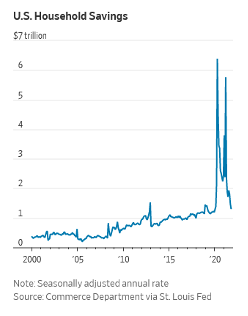
The Wall Street Journal reported personal spending rose 0.6% in November compared with 1.4% in October. Many consumers purchased holiday gifts earlier this year because of fears of shortages. Overall, the consumer is still in good shape, with unemployment around 4.2% and personal savings of over $2.5 trillion.  However, the labor participation rate is still lower than in the past (see chart) and the personal savings rate, albeit still relatively high, is back to around pre-pandemic levels. As we have written in previous updates, economists were unsure how much demand was pulled forward because of certain product shortages on top spending down of the stimulus checks in 2020 and early 2021.

Bloomberg: New Study Shows Omicron Has 80% Lower Risk of Hospitalization:

The Omicron variant spreads much faster than the previous variants. However, these infections are 80% less likely to be hospitalized if they catch it. Unfortunately, if admitted to the hospital, the risk of severe disease is like the previous two. As many of us are somewhat numb or tired of hearing about Covid-19, the risks of illness for many still exist. The US reported nearly 240,000 new cases yesterday. Dr. Fauci said earlier in the week that the peak wave for Omicron would come much faster and the risk of infections are much higher for the unvaccinated. There have been many vaccinated people contracting Omicron, but the symptoms have been much milder on balance.

Build-Back-Better Act Derailed Again:

West Virginia Democratic Senator Joe Manchin has put a wrench in the legislation, citing concerns over the spending bill’s effects on inflation and debt levels. Senator Manchin has rejected certain provisions like extended paid leave plan, and a program aimed at pushing utilities to use more clean energy. President Biden has publicly stated that a deal will get done.  The bill has already come down from $3.5 trillion to around $2 trillion. Senator Manchin has publicly stated that he would only support up to $1.5 trillion in spending.  With the Fed accelerating bond purchases and signaling rate increases in 2022, this fiscal stimulus could be even more important for the economy in 2021.

Market In A Snap! December 6th-December 10th, 2021

By: Jeff Anderson, CFA

This Week: It was a rather volatile week for many companies.  A number of high-flying technology stocks fell on hard times, sending some shares down 40% or more.  You wouldn’t know it from looking at the returns of the major indices.  The S&P 500 and Nasdaq indexes are dominated by a handful of large companies, and they have held up well.  Apple’s market value is approaching $3 Trillion, essentially drowning out the noise from the smaller companies in theses indexes. 

 CloseWeekly returnYTD return
    
S&P 5004,712.983.82%25.45%
Nasdaq15,630.63.61%21.28%
Russell 2,0002,210.662.38%11.93%
US Treasury 10yr Yield1.488%  

Source: Wall St. Journal

Crude oil had a decent week, gaining nearly 9% to $72 per barrel, but well off its highs in October where it hovered around $82.  Oil traded down to nearly $10 in April 2020 when the economy was shut down due to the pandemic.  The dramatic increase in oil prices is more a function of return-to-normal price ranges. 

This Issue:

  • Market Update
  • US Jobless Claims Fell to Lowest Level in Half a Century
  • US Inflation Hits a Multi-Decade High in November

U.S. Jobless Claims Fell to Lowest Level in Half a Century

There’s a shortage of labor.  The labor participation rate is almost 2% lower than pre-Covid.  Economists have coined this period as “The Great Resignation”.  People are leaving the workforce.  Some are retiring, while others are taking time off in hopes of recharging their batteries and finding a better paying, more fulfilling career path.  We could also call this post-Covid world “The Great Mobility” as many US workers were able to move thousands of miles away from their offices where they can reduce their cost of living or seek a more balanced lifestyle.  Whatever the reasoning, it is increasingly harder for employers to find good employees, and when they do, it usually costs more.

US Inflation Hits a Multi-Decade High in November

The economic headlines have been dominated by inflation numbers for several months now.  Despite the high reading, it was to be expected.  Bond yields actually moved lower.  Why is that? It’s all about expectations.  Since the 6.8% print was not a surprise, there was nothing to spook the bond markets.

The broader indexes took this all-in stride, with the large cap indices all finishing higher on the day.  Consumers are flush with cash and willing to spend.  Unemployment is low.  Wage gains are helping.  Corporate profits, so far, are growing, meaning that they can pass along price increases.  How much of consumer purchases is pulling forward future demand as people rush to buy goods that may cost more later remains to be seen. 

Exit mobile version
%%footer%%